Our Vision
"The hands are the instrument of man's intelligence." — Maria Montessori
Long before children can explain an idea in words, they can act it out with their bodies. Our research asks a simple question with a complicated answer: what if we designed STEM learning around that fact, instead of around it?
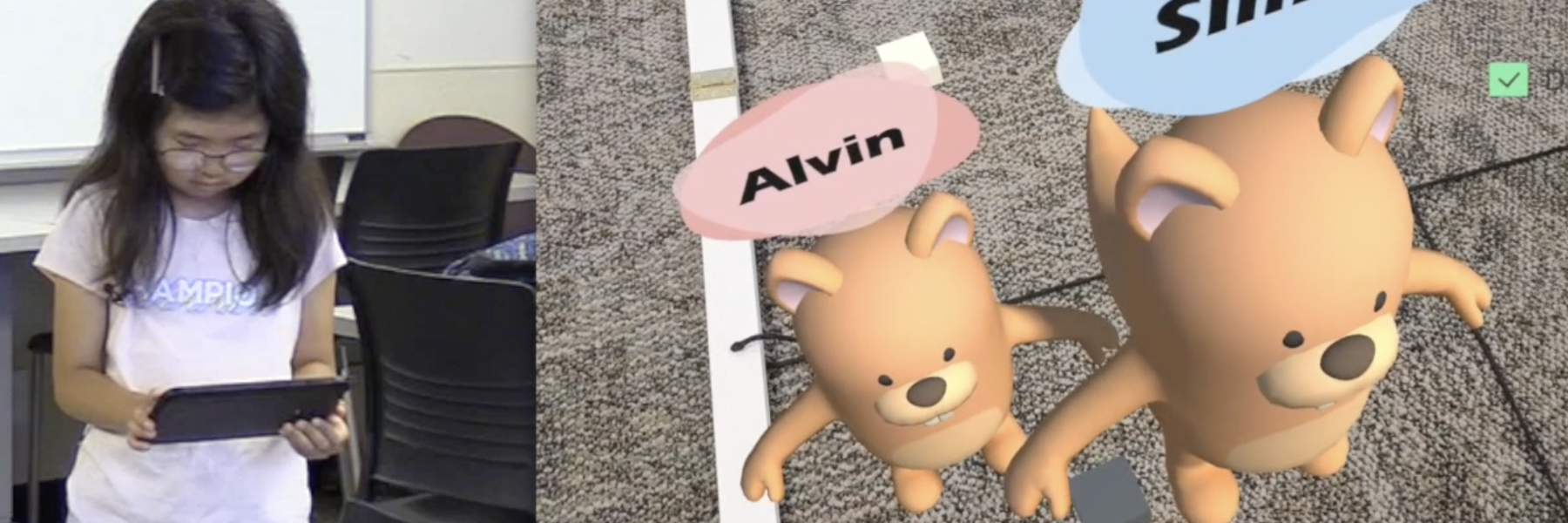
Across three NSF-funded projects, we design, build, and study embodied robots and mixed-reality (AR/VR) tools that let children move through the STEM concepts most classrooms can only show them on a slide — a sequence of computational steps, the invisible flow of blood through the body, the atomic-scale switching of a transistor. Rather than asking children to sit still and absorb abstraction, we invite them to walk it, wear it, build it, and play it with a robot at their side.
Societal Needs
These projects respond to a challenge that starts early and compounds over time. National data continue to show stagnant K-12 achievement in math and science, a persistent underrepresentation of girls, Black students, Hispanic students, and English learners in STEM fields, and — most recently — a projected shortfall of more than 100,000 domestic semiconductor and electronics jobs that current education pipelines are not positioned to fill.
Much of this gap traces back to access and abstraction. STEM's most important ideas are often invisible — a computational sequence, a biological process happening inside the body, an electrical phenomenon occurring at the atomic scale — and many classrooms and communities, particularly those serving low-income and historically underrepresented students, lack the specialized tools, equipment, or exposure needed to make these ideas tangible. Left unaddressed, this gap does not stay contained to one grade level; it accumulates from early childhood through adolescence and narrows the STEM pipeline before students ever reach the careers this technology will define.
Pedagogical Approach
All three projects share a common theoretical foundation and a common way of working:
- Embodied cognition as the design principle. Decades of research show that thinking is not confined to the head — it is shaped by bodily movement, gesture, and interaction with the physical world. Each project translates this theory into a concrete technology: a social robot and floor-grid AR experience for young children, an on-body robot that travels along a child's arm to visualize circulation, and tangible toolkits paired with AR/VR to make semiconductor fabrication touchable.
- Robotics and mixed reality as a bridge, not a gimmick. Physical robots and AR/VR layers are used specifically to connect a child's real, bodily actions to the symbolic or invisible concepts underneath — sequences and symbols, biological systems, semiconductor physics — so the technology does pedagogical work rather than just entertaining.
- Culturally responsive, co-designed curricula. Every project is built with the children, teachers, families, and community partners who will use it — not designed in isolation and handed to them. Co-design sessions, teacher workshops, and community makerspace partnerships shape what gets built at every stage.
Iterative, design-based implementation research. Each project moves through the same rhythm: understand real classroom or community needs, prototype and test in small iterative cycles, then deploy and evaluate at scale with a comparison group — ensuring what we build actually works in ordinary settings, not just the lab. - Computational thinking as a throughline. Whether the subject is play, biology, or semiconductors, each project treats computational thinking — breaking problems into steps, recognizing patterns, generalizing solutions — as a foundational literacy that belongs in every STEM domain, not just computer science class.
Pipeline Across Childhood
Our three projects are intentionally staged across the ages when STEM interest and identity take root:
| Project | Status | Age Group | Setting | Core Idea |
| Embodied CT | Completed | Grades K-2 | School | Computational sequences & symbols, via a social robot playmate and AR |
| Bio+CS | Ongoing | Grade 5 - 6
| School | Human body systems & computational thinking, via an on-body embodied robot |
| SILICON | Ongoing | Middle school | Informal Learning | Semiconductor principles & fabrication, via tangible toolkits and AR/VR |
Taken together, they form a developmental throughline — the same commitment to embodiment, inclusion, and hands-on discovery, adapted to meet learners where they are, from a kindergartner's first steps on an AR floor grid to a middle schooler building a transistor model in a community makerspace.